
Daily Lesson Evaluation: How a Madrasa Records Whether Each Student Knew the Lesson
In Sabaq a teacher opens one sheet for the whole month, with students down the side and dates across the top, and marks each student’s lesson for the day as good, medium, weak or absent. The month and year totals build themselves, the sheet prints with signature boxes, and guardians can see their own child’s record. It is used by 728 institutions in 62 districts of Bangladesh, from 500 BDT per month.
| What it is | A daily record of whether each student knew the day’s lesson, kept per class, per subject and per book, with monthly and yearly totals. |
|---|---|
| Who it is for | Hifz, noorani, nazera and kitab classes, and any department where the lesson is heard every day. |
| Languages | The interface runs in Bangla, English and Arabic. Support is given in Bangla. |
| Where it runs | Teachers enter and guardians view this in a web browser. It is not in the Android app. |
| Price | 500 BDT per month, 5,000 BDT per year or 20,000 BDT one time, per madrasa. Installation is 2,000 BDT under 200 students and 5,000 BDT above that. |
| In use by | 728 institutions in 62 districts of Bangladesh. |
Prices and figures on this page were checked on 10 September 2026.
Why keep a daily lesson record at all?
In most madrasas a guardian hears from the institution three times a year: at admission, when fees fall behind, and when the annual result comes out. For the nine months in between, nobody outside the classroom knows whether a child is keeping up. When the result is poor, the first complaint is always the same: why were we not told earlier.
The teacher usually does know. The problem is that the knowledge lives in their head or in their own notebook, so when a teacher changes, the institution loses it. Writing the daily lesson down is as much for the madrasa as for the guardian.
What does the teacher actually see?
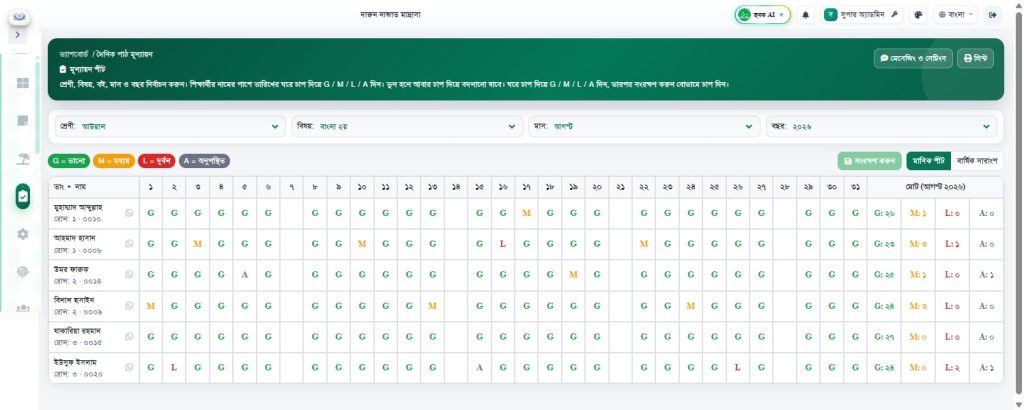
One sheet for the whole month. The teacher picks the class, the subject, the book and the month, and gets a grid: student names down the left, the dates of that month across the top, and the month’s totals at the right hand end.
Marking is a single tap in the cell where a student’s row meets today’s date. There are four values, and four is deliberate: more than that and teachers stop using it, fewer and the picture is too coarse.
| Mark | Meaning |
|---|---|
| Good | Knew the whole lesson without stumbling |
| Medium | Knew it, but stopped in a few places |
| Weak | Did not know it, or a large part was missing |
| Absent | Was not in class that day |
A mistake can be corrected by tapping the cell again. A future date cannot be marked at all, which is what keeps the record worth reading: nobody can fill in a week in advance.
Who fills it in, and when?
Whoever hears the lesson fills it in, and does it in the classroom before leaving. Both halves of that sentence matter.
If the office copies it in later from a teacher’s paper, two things go wrong. Transcription introduces errors, and the same work is done twice, so before long neither person does it carefully. Holidays and exam days simply stay blank, which is correct; there is no need to fill them.
How is this used in a hifz or noorani class?
These are the departments where it earns its keep, because the lesson is heard every single day. The difference from a general class is that the record is usually kept per book rather than per subject, and Sabaq lets the class, the subject and the book each be chosen when the sheet is opened.
Teachers in these classes commonly speak of the new lesson, the recent revision and the older revision as separate parts of the day’s work. If your madrasa wants those tracked apart, set each up as its own entry when the sheet is created, and each will then carry its own monthly total. What the guardian sees is the same in either case.
What does the guardian get?
Two things. If the madrasa turns it on, a message goes out at a fixed time each day with that day’s result, by SMS or by the institution’s own WhatsApp service. And the guardian can open their own panel and read the whole month rather than a single day.
One piece of advice from madrasas that have run this for a while: do not send only the day’s mark. Send the month’s running count with it. A guardian who receives nothing but bad news every evening stops opening the messages within a fortnight, while one who can see that four weak days have become one is being told something useful.
A guardian sees only their own child. They do not see other students’ marks or any class ranking.
What comes out at the end of the month?
The totals build themselves as the month goes, so nothing has to be added up. Each student’s row carries a count of good, medium, weak and absent days, and the same totals exist for the year.
The sheet prints with boxes for the class teacher and the head teacher to sign, which is what makes it usable in a committee meeting or a guardians’ gathering rather than only on screen. It also gives an incoming teacher something to read on their first day.
Is this in the mobile app?
No. Daily lesson evaluation is entered by teachers and read by guardians in the web panel. The Android app carries attendance, fees, results and notices. Saying so plainly here saves a support call later. The app itself is described on the parent app page.
What does it cost?
Nothing on top of the plan. Daily lesson evaluation is included like every other module: 500 BDT per month, 5,000 BDT per year or 20,000 BDT one time per madrasa, with installation at 2,000 BDT below 200 students and 5,000 BDT above that. SMS is the one thing charged by use, because the operator charges for each message. The full list is on the pricing page.
How should a madrasa start?
With one or two classes, not the whole institution. Let one teacher use it for a month, fix whatever annoys them, and let the guardians of that class get used to the message arriving. Once both sides are comfortable, the rest of the madrasa follows quickly because there is someone in the staff room who can explain it.
Want to see the sheet for your own classes?
Tell us your classes, subjects and books, and we will set them up in a demo so your teachers can try a month.