
Madrasa Accounting Software: Will the Books Stand Up at Year End?
Sabaq keeps madrasa accounts in double entry, not in a single list of income and expenses. There is a chart of accounts, four voucher types, a general ledger, a day book and a cash book, and from those it produces a trial balance, a balance sheet, a profit and loss statement and the income and expense statement a committee asks for. It is used by 658 institutions in 62 districts of Bangladesh, from 500 BDT per month.
| What it is | The accounting side of Sabaq madrasa management software: double entry books, vouchers, ledgers and the standard financial statements. |
|---|---|
| Who it is for | The person who keeps the madrasa’s books, and the committee that has to approve them once a year. |
| Languages | The interface runs in Bangla, English and Arabic. Support is given in Bangla. |
| Where it runs | Runs in a web browser on any device. The companion app is Android only, through the Play Store. |
| Price | 500 BDT per month, 5,000 BDT per year or 20,000 BDT one time, per madrasa. Installation is 2,000 BDT under 200 students and 5,000 BDT above that. |
| In use by | 658 institutions in 62 districts of Bangladesh. |
Prices and figures on this page were checked on 10 September 2026.
What does a madrasa actually need from accounting software?
A madrasa needs four things from its books, and they are not the same as what a shop needs. It needs every taka that came in to be tied to a numbered receipt. It needs money given for one purpose to stay separate from general money. It needs to answer, at any point in the year, how much is in hand and how much is in the bank. And it needs to put one page in front of a committee that shows the year without anyone having to trust the person who wrote it.
Software helps with the arithmetic and the retrieval. It does not help with the discipline. If a receipt is not written, or a voucher is not kept, no system can produce a book that stands up.
Is this double entry accounting or just an income and expense list?
Double entry. Sabaq has a chart of accounts, so every transaction is posted against a named account rather than a free text category. That is the difference between a system that can produce a trial balance and one that can only add up two columns.
The practical effect is that the books can be checked against themselves. If a transaction went in on one side and not the other, the trial balance will not agree, and the error can be found before the committee sees it.
What are the four voucher types and when do you use each?
Every entry in Sabaq is made through one of four vouchers. Choosing the right one is most of the skill in day to day bookkeeping.
| Voucher | Use it when | Madrasa example |
|---|---|---|
| Receipt | Money comes in | A guardian pays the monthly fee, or a donor gives chanda |
| Payment | Money goes out | Teacher salary, the boarding bazar, an electricity bill |
| Contra | Money moves between your own cash and bank | The day’s collection is deposited in the bank |
| Journal | An adjustment with no cash movement | Recording depreciation, or correcting a posting |
Keeping contra entries separate matters more than it sounds. A madrasa that records a bank deposit as an expense and then as income has counted the same money twice, and that single habit is behind a large share of year end disagreements.
Which reports come out of it?
The reports are the reason for the structure above. Sabaq produces them from the same entries rather than asking anyone to prepare them separately.
- General ledger: every account on its own page, with its running balance
- Day book: everything that happened on a given day, in order
- Cash book: cash in hand, separate from bank
- Trial balance: all debits against all credits, so a one sided entry shows up
- Balance sheet: what the madrasa owns and owes at a chosen date
- Profit and loss: income against expenditure for a chosen period
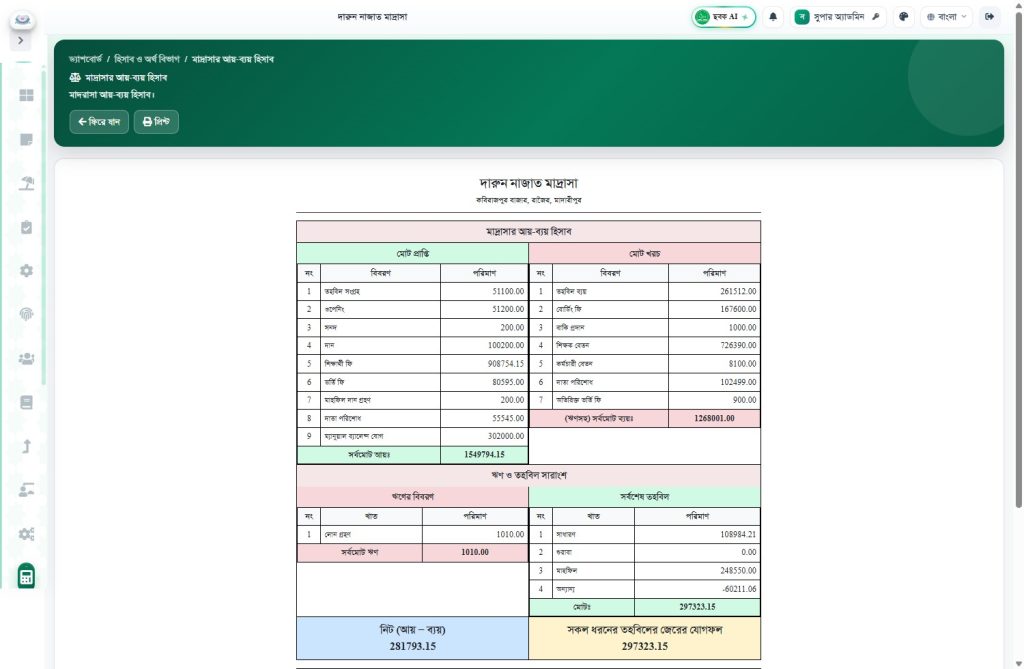
- Income and expense statement: the page a madrasa committee usually asks for, head by head
- Fixed asset register: assets with depreciation recorded against them
How are funds kept apart?
Most madrasas hold more than one pot of money. There is general money, and there is money given for a specific purpose, most often the lillah fund that feeds and houses poor and orphan students. Mixing them is the fastest way to lose a donor.
In Sabaq each fund is a named record with an opening balance and a running balance. Entries are posted against a fund, money can be moved from one fund to another with the transfer recorded rather than assumed, and the income and expense statement shows the closing balance of each fund separately. How to organise that on paper as well as in software is covered in keeping lillah and general funds separate.
Do fees and donations reach the accounts by themselves?
Yes, and this is the part that saves the most time. When a guardian pays, the receipt is the accounting entry. The dues list, the student’s own ledger and the fund balance all move from that one action, so nobody re enters anything into a second book.
The same is true of an online payment. When a guardian pays from the parent panel, the receipt is created as an ordinary fee receipt, so the month end totals include it without a separate reconciliation step. What has to be set up before that works is on the online fee collection page.
What about salaries, advances and deductions?
Salary is usually the largest single expense in a madrasa, so it is worth recording properly rather than as one lump. Sabaq records the gross salary, any deduction with a written reason, the net payable after that deduction, what was actually paid and what is still owed, and the fund the money came from. Advances and loans are held in their own section so they are not mistaken for expenditure. The detail is on the teacher salary page.
Where do most madrasa books go wrong?
The failures repeat across institutions, and almost none of them are arithmetic.
| What goes wrong | What prevents it |
|---|---|
| Cash taken with a promise to write the receipt later | No receipt, no money. One exception ends the rule |
| A discount agreed verbally and never recorded | Treat a discount as an entry, with the name of whoever approved it |
| The boarding kept in a separate notebook | A separate fund is fine, a separate book is not |
| An advance to a teacher booked as an expense | Advances sit in their own list until the salary settles them |
| A bank deposit recorded twice | Use a contra voucher for movement between your own accounts |
| Spending with no voucher | Write your own voucher and get a signature rather than leaving a gap |
Will these books satisfy an auditor?
An auditor does not check your software, they check your evidence. What they look for is that receipt numbers run in sequence with none missing, that every payment has a voucher with a signature, that large collections reached the bank, and that big decisions were minuted before the money moved.
Sabaq gives you the first three quickly, because receipts are numbered by the system, payments carry a voucher, and the cash book and bank figures are separate. The minutes are still a human job. No software makes a madrasa audit ready on its own, and any vendor who says otherwise is selling something.
Does it replace an accountant?
No, and that is worth being plain about. It replaces the copying, the adding up and the searching. Someone still has to decide which head a payment belongs to, chase what is owed, and explain the year to a committee. In a small madrasa that person is often the office clerk rather than a trained accountant, which is exactly why the chart of accounts is set up once at installation rather than left blank.
How much of this is included in the price?
All of it. Accounting is not a separate module with a separate price in Sabaq. The plan is 500 BDT per month, 5,000 BDT per year or 20,000 BDT one time per madrasa, with installation at 2,000 BDT below 200 students and 5,000 BDT above that. The full list is on the pricing page.
Want to see the books on your own numbers?
Tell us your funds and your heads of income and expense, and we will set them up in a demo so you can see the statements come out.